Rarest of Them All?
On this page we will feature some of the rarest knives we have personal knowledge or possession of. Some of these knives come with stories but they seldom come with document-able proof. So unless we know it is an out and out lie, we will tell you what we were told and then let you do your own research. One general clue as to whether a knife is counterfeit or not is the price. It little behooves a man to counterfeit a knife and then sell it for just a few dollars. This is not proof positive, but the more mysterious and expensive a knife is, the more cautious you should be.
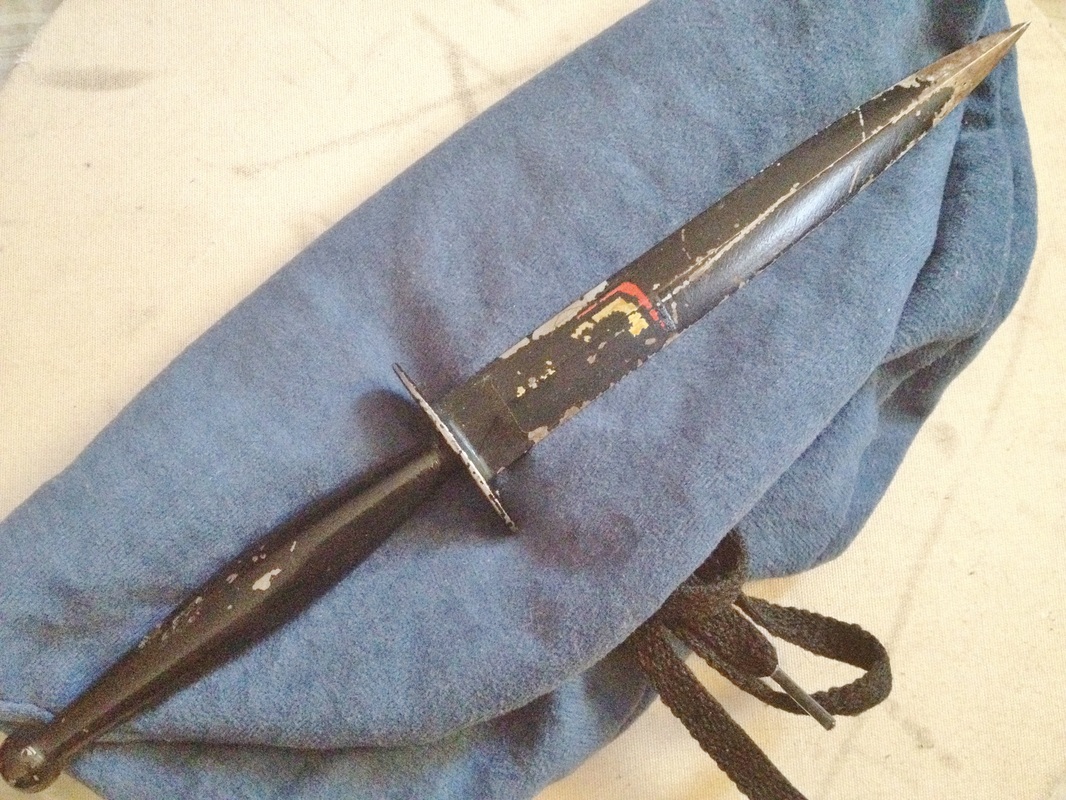
Below: I need to take a better photo of this knife but for now here it is. The story behind it is rather bizarre, saying it was used by crewmen of the British WW-II mini-submarines. I am not sure that I believe that, but that it is rare is definitely true. The hex shaped handle is solid brass.
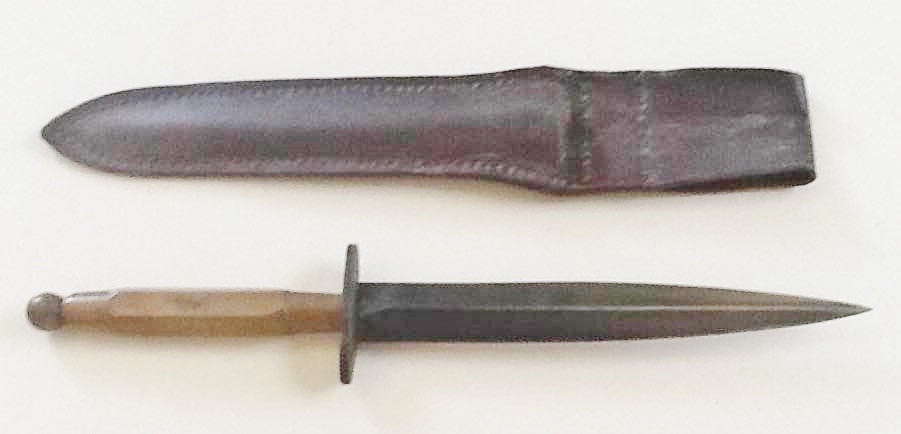
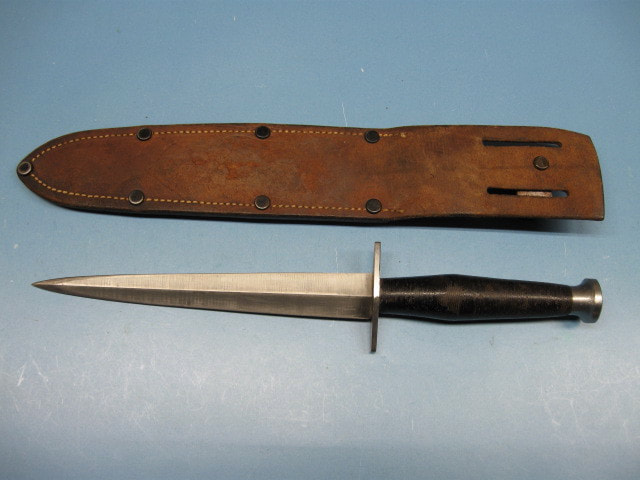
Below: I think this knife may be shown on another part of this site but i cannot find it myself! I guess the web site is getting too big. It is yet undetermined whether it is a second or third pattern. It is marked on the guard "42" which is normally for a 3rd pattern but i cannot feel any ribs under the leather. Some experts have said these were made for use in very hot climates, perhaps even during the Suez crisis. It is in mint condition and extremely rare. The tight fit of the leather is simply incredible!
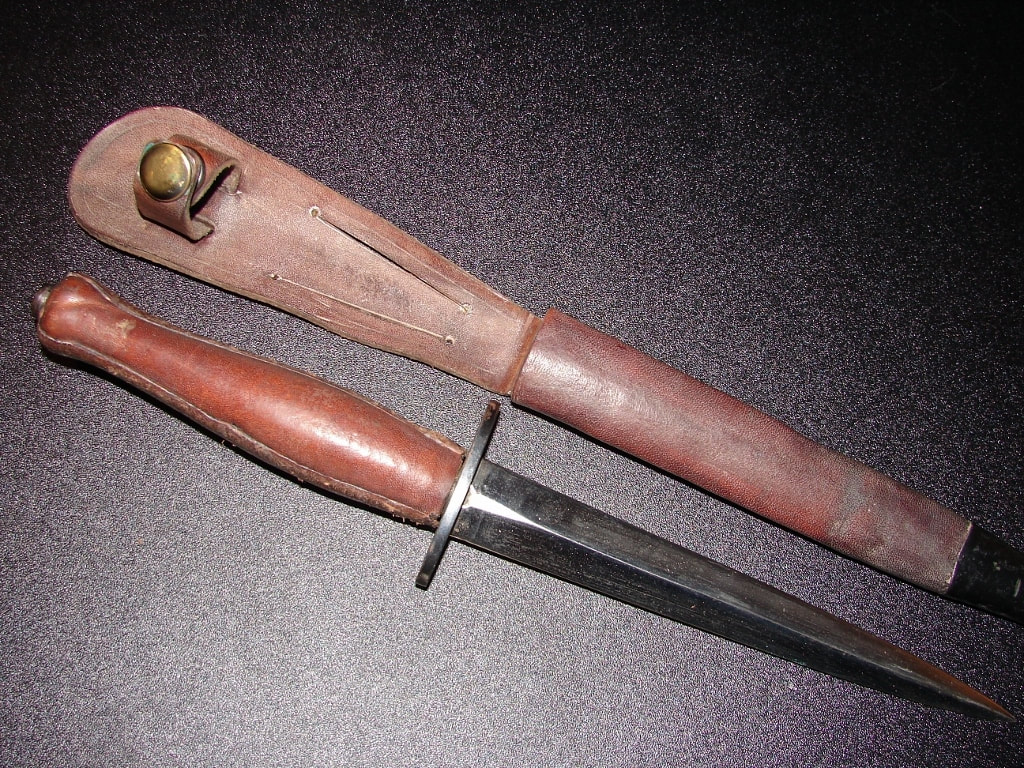
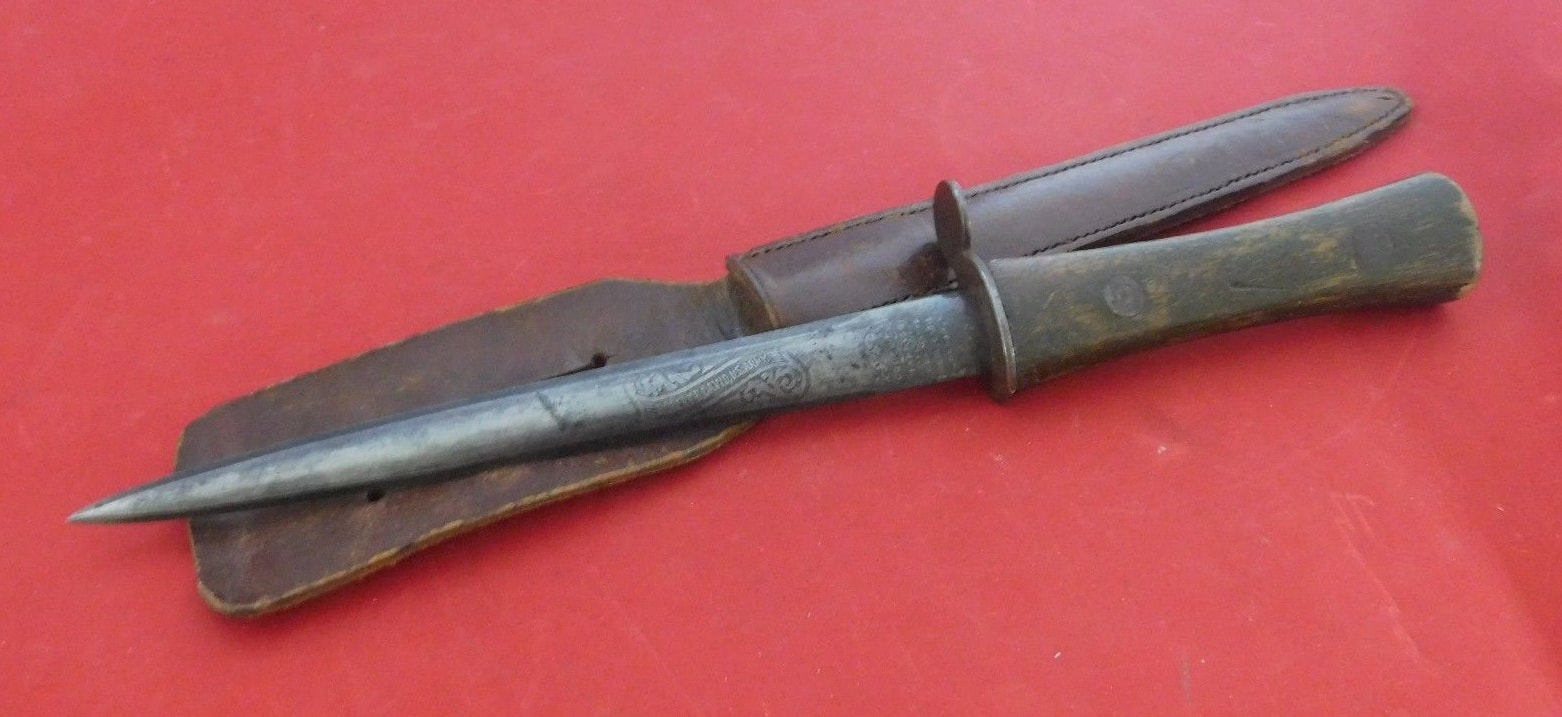
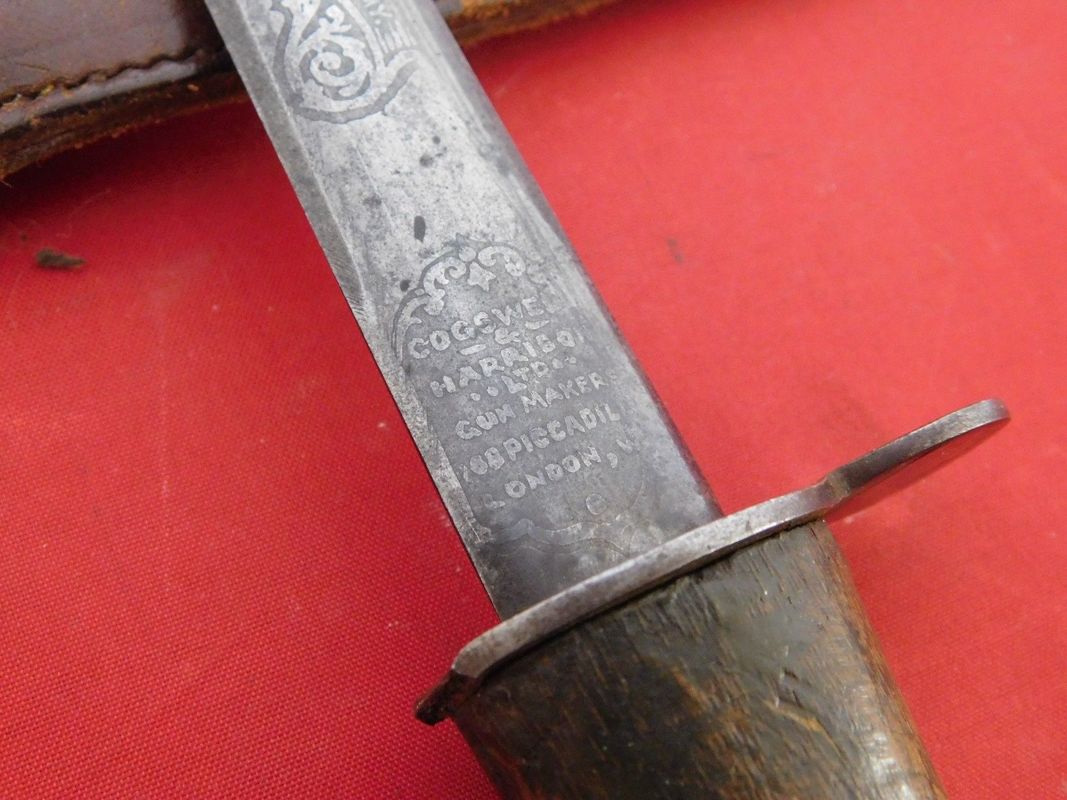
Below: Along with the Shakespear Knife these are among the more difficult British fighting knives to find. I keep using the word "rare" and while its true, I know I have over-used it. For many years I have been looking for one of these knives sold by Cogswell & Harrison Gunmakers. The first time i saw one was in Ron Flook's book on London knife makers. Since then the hunt has been on. I got this one on Ebay while looking for Fairbairn knives. You never know where you will find a knife. It is in very good condition with the exception of one side of the guard has been broken off. It looks as though it got bent and probably snapped off when the owner tried to straighten it. Luckily it is nicely etched with the original owners name, "Robert B. David U.S. Army." I have found a man by that name who served in WW-II. These are often considered WW-I vintage so I am not sure if that is the right person. Mr. Flook suggested they were made by another company (Wilkinson Sword Co.) and retailed by Cogswell & Harrison who were notable gun makers since the 1770s.
|

|
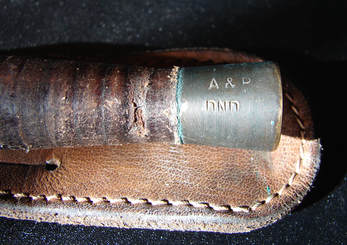
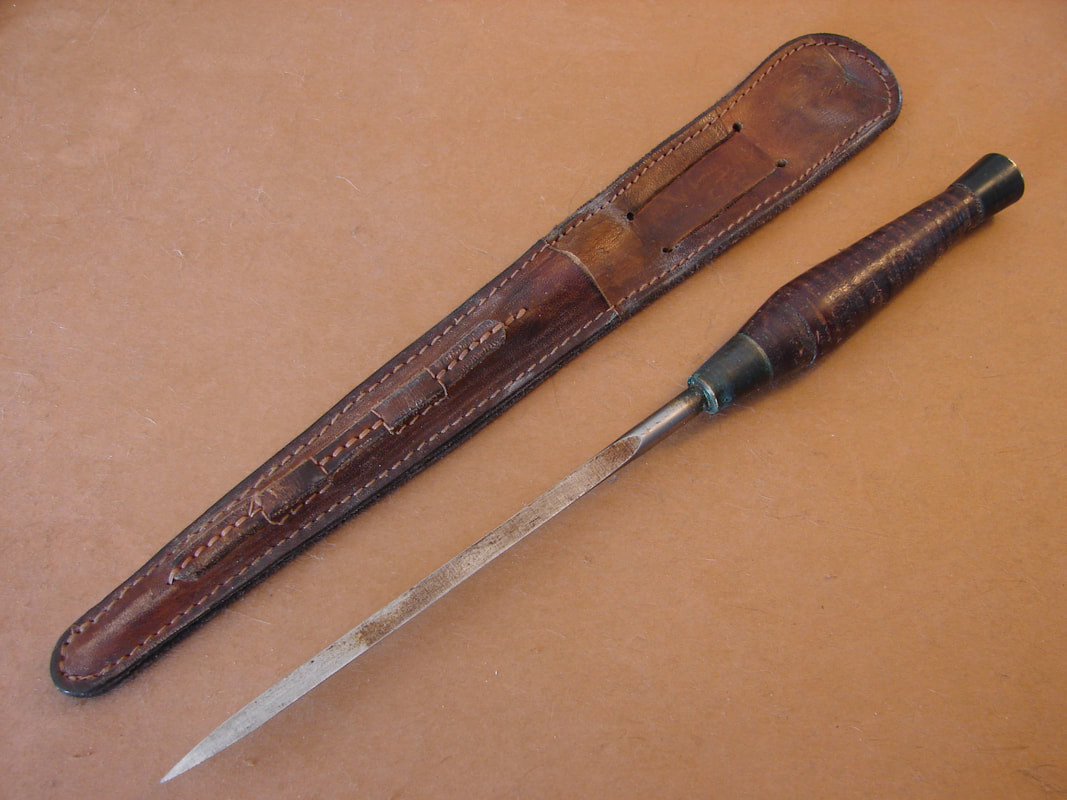
Below: The death rate among members of the S.O.E. was possibly as high as 30%. Therefore their weapons are somewhat rare and one as unique as this one is exceptionally uncommon. I bought it from a collector who could vouch for its provenance to an agent working out of Poona, India. The method of construction is identical to that of a Faircane and the original owner also owned one of the lethal canes. In this case the steel rod core is ground into a tri-cornered blade and mounted with a turned brass ferrule and pommel. The handle itself is layered leather washers shaped to mimic a Fairbairn-Sykes knife. It is a truly wonderful addition to our collection! I thought the only marking anywhere was a No. "6" stamped into the top of the pommel. I was mistaken about this. As the knife lay on my desk a ray of sunshine revealed markings I had not noticed on the side of the pommel, "A&P" and "DND". The owner was said to prefer this stiletto to a standard F-S knife because of its ability for deep penetration, like thrusts behind the clavicle.The blade is certainly long enough to reach the heart from that point of entry.
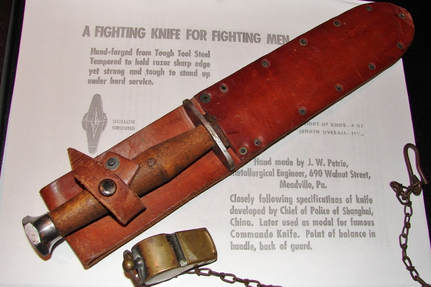
Below: An extremely rare J.W. Petrie Commando knife. During WW-II Petrie was a metallurgist in Meadeville, PA. He made and donated fighting knives to men headed off to war. The hollow ground blade is very sharp with some of the original finish left. The mounts are a stainless steel i believe. The wooden handle was originally covered with a cord wrapping but it was like this when I bought it. The original sheath accompanies it and is boldly marked on the back "MURPHY". This is only the second Petrie knife i have ever seen for sale. I am trying to discover more about Mr. Petrie and his knife production numbers. If you have any information please contact me. I suppose finding out much about Mr. "Murphy" will be even harder.He was probably local to Meadeville, PA. Amazingly I managed to buy another J.W. Petrie knife in even better condition. Two in one year after never finding one for over 30 years is pretty good luck. For some reason someone (idiot) ground off the facets on the pommel making it round???
|
|
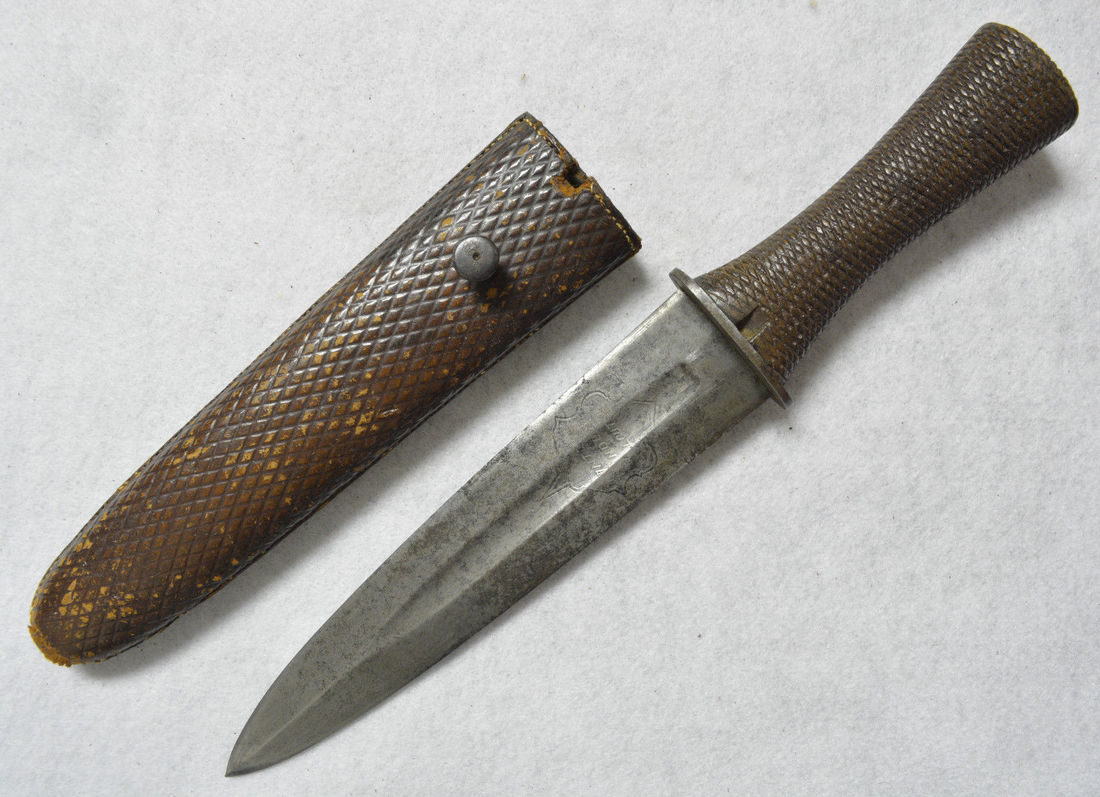
Below: A museum quality, extremely rare, knife that some suggest might have influenced the F-S knife design. Personally I doubt that, but I can assure you this is an example of a knife I have pursued for a long time. It is known as a "Shakespear Knife" named after British Army Major William Henry Shakespear who designed it for use while hunting dangerous game in India. It was made by Wilkinson Sword Co. When John Fairbairn said their first knives were inspired by a fine looking hunting knife it might have been one like this.
This information was provided by Wilkinson Sword knife expert, Roy Shadbolt. "Gosh, a lovely knife, very well done. All of these seem to be quite unique and yours is no exception, having some interesting details. You have a No2 Shakespear knife almost certainly made by Wilkinson for Manton of London & Calcutta. Manton would have retailed this most likely in their Calcutta (India) store. This is not the first time I have seen them retail knives with their own etchings but made by Wilkinson. It is unusual to see a No2 with a fullered blade as these are normally found on the largest No5 knife. Without a serial number it is impossible to conclusively date but from the details of construction I would say 1870's"
"Born in India in 1871, Captain William Shakespear was one of the last Victorian explorers - nothing daunted him and the more difficult the task the more pleasure he derived from carrying it out.
Captain Shakespear was a talented linguist, fluent in six languages, a pioneering explorer, accomplished photographer, negotiator, horseman and sailor - an all-round man of action. From 1898 he served in India with the Devonshire Regiment and Bengal Lancers, before moving to the Indian Political Department.In 1904, Shakespear became Consul at Bandar Abbas, Iran; it was from here that he undertook his first major expedition, driving his Rover from the Persian Gulf to the UK in 1907 - an incredible accomplishment at a time when cars were in their infancy." http://freepages.genealogy.rootsweb.ancestry.com/~shakespeare/military/capt_wm_hy/biog.htm
As a child I remember watching a TV show called "The Bengal Lancers." That was in the days of black and white TV and at 11:00 PM every night the networks shut down. The shows were wonderful and you could let a child watch TV back then without all of the sick perversity, gratuitous violence, and sexuality found on TV today. Ahhh how I long for the good ole days.
Captain Shakespear was a talented linguist, fluent in six languages, a pioneering explorer, accomplished photographer, negotiator, horseman and sailor - an all-round man of action. From 1898 he served in India with the Devonshire Regiment and Bengal Lancers, before moving to the Indian Political Department.In 1904, Shakespear became Consul at Bandar Abbas, Iran; it was from here that he undertook his first major expedition, driving his Rover from the Persian Gulf to the UK in 1907 - an incredible accomplishment at a time when cars were in their infancy." http://freepages.genealogy.rootsweb.ancestry.com/~shakespeare/military/capt_wm_hy/biog.htm
As a child I remember watching a TV show called "The Bengal Lancers." That was in the days of black and white TV and at 11:00 PM every night the networks shut down. The shows were wonderful and you could let a child watch TV back then without all of the sick perversity, gratuitous violence, and sexuality found on TV today. Ahhh how I long for the good ole days.
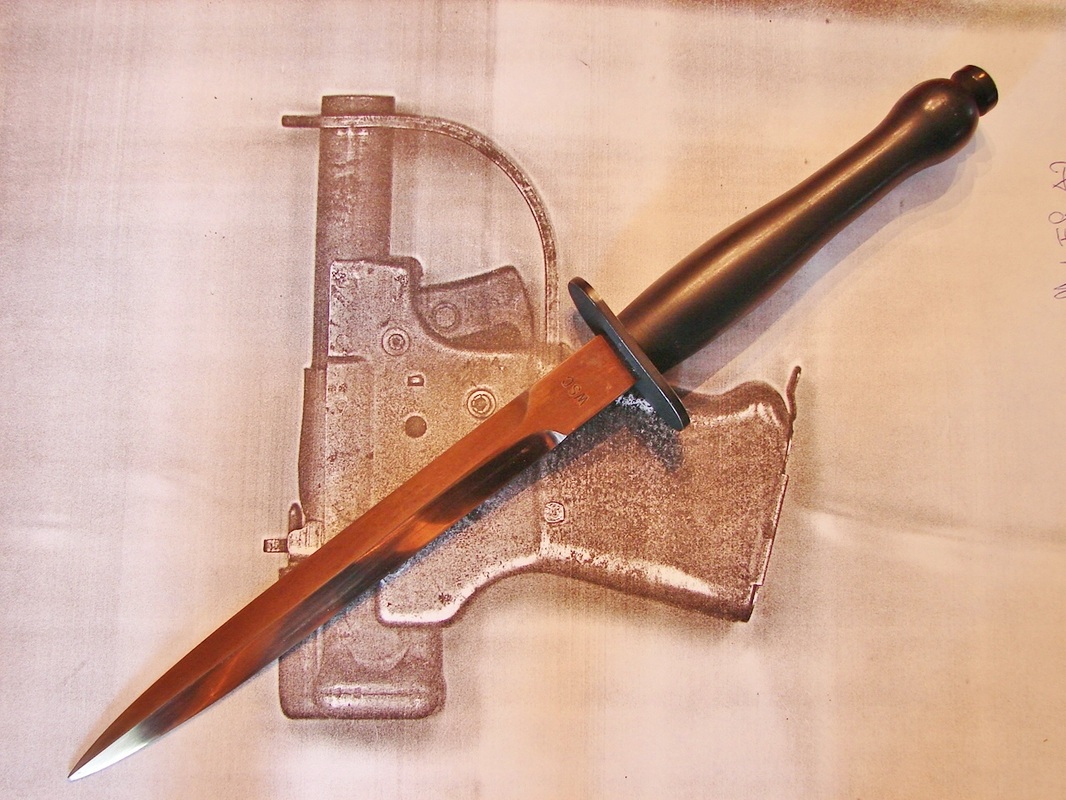
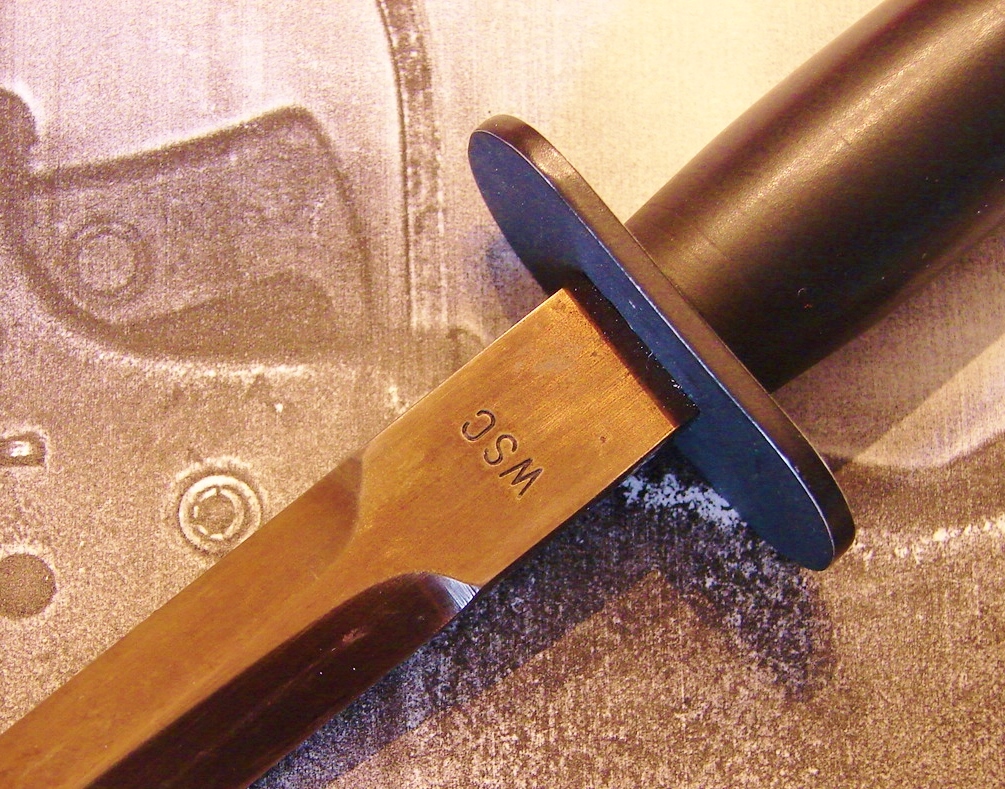
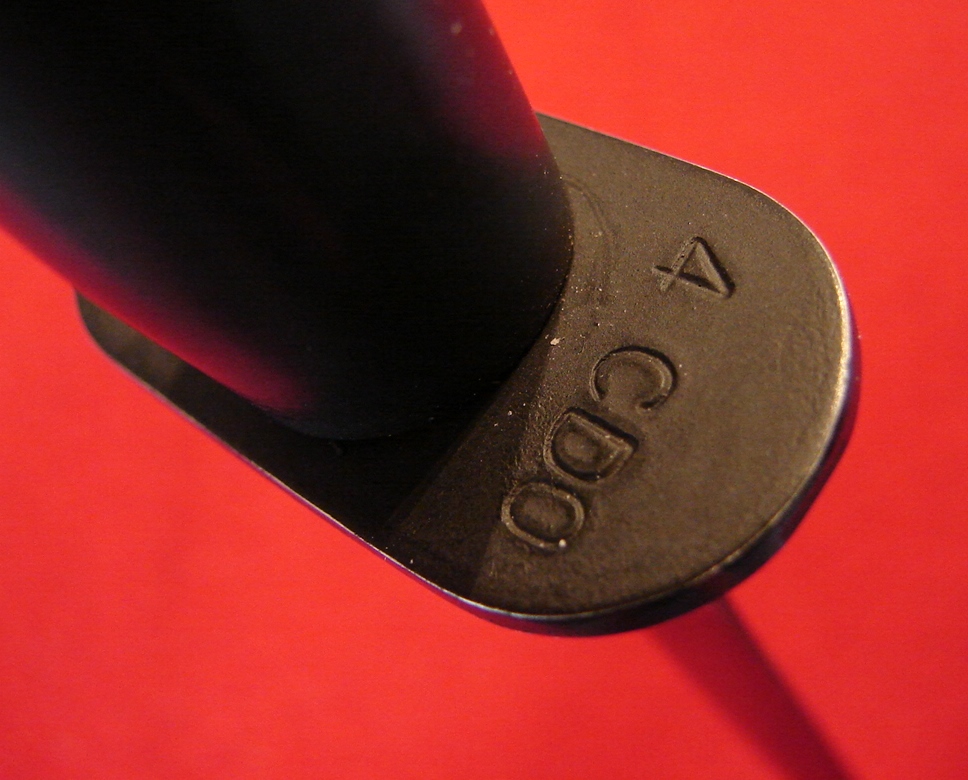
Below: Another very rare commando (clandestine) dagger that came from Capt. Mason's personal collection. Note the similarity between it and my No. 4 Cdo, Lovat Dagger. This knife is crisply stamped "WSC" on the ricasso. On the guard this one is actually stamped "4 CDO." (these may have been cut with a pantograph.) This would have been Lord Lovat's No. 4 Commando. The aluminum handle is perfectly smooth and heavily coated with some form of blackening. The nearly rectangular guard has rounded ends and is made of some non-ferrous material. One of the most unique things about the finely ground blade is that it has a lovely gold/bronze tint to it. This is most likely from a tempering process. The bronze color is created by re-heating the hardened blade to about 480 deg. F and rapidly quenching it to reduce the brittleness.
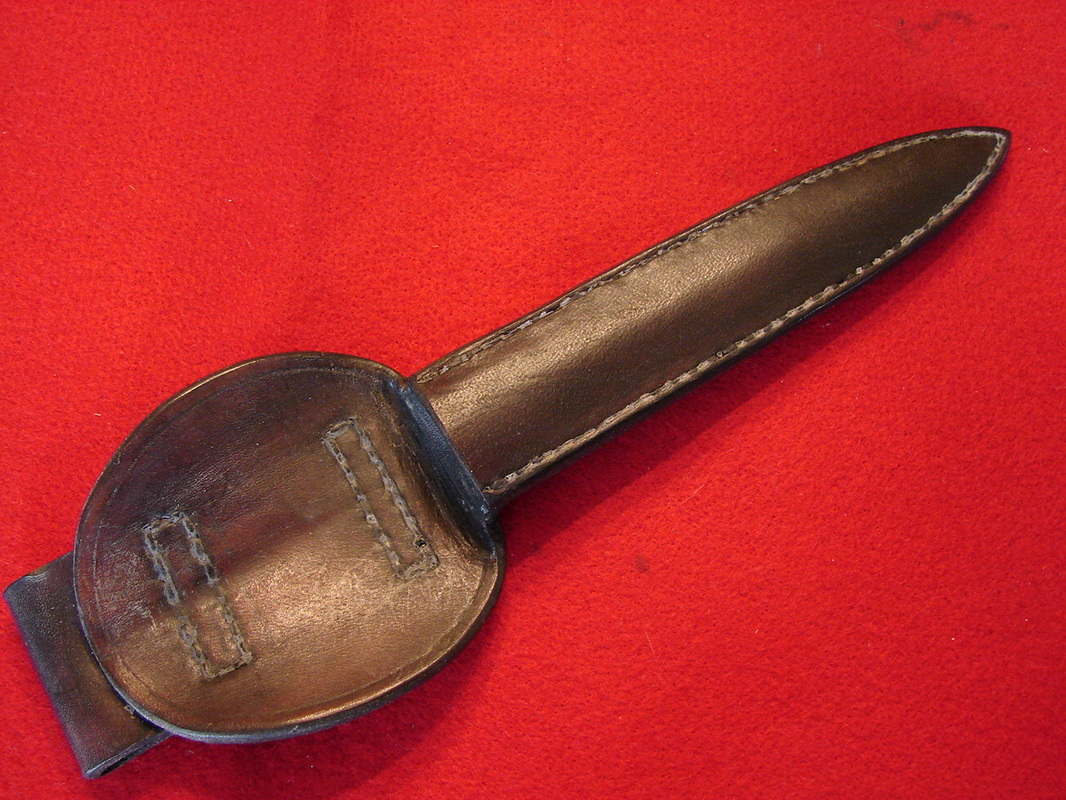
Below: Here are some detailed photos including the blade and guard stamping. I have found documentation that the sheath was made in 1948 for Capt. Mason in Germany by Puma, Edged Weapons Agents at his request, but it did not turn out as he instructed. Something must have been lost in the translation It is made from very heavy leather and can be worn in several different ways. It will actually accommodate a full sized F-S knife. NOTE the 1948 date!
|
|
|
The Rarest of the Rare?
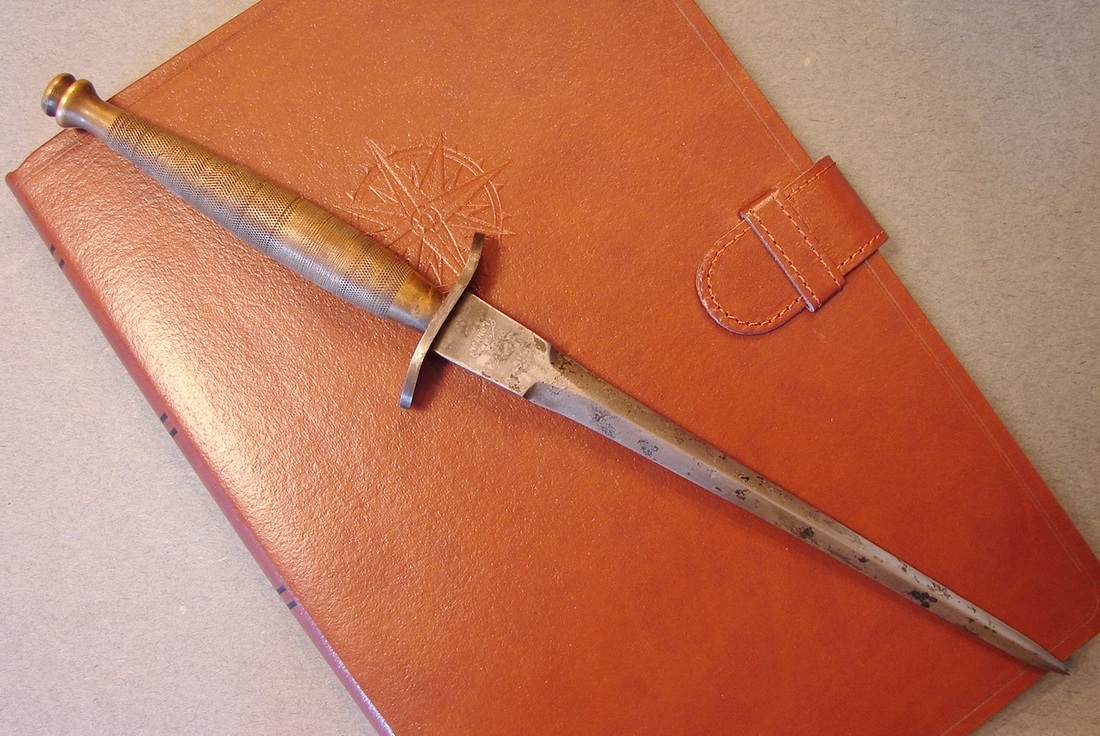
Below: Perhaps not only one of the rarest of the commando knives in our collection but this may be one of the rarest Wilkinson Commando knives ever! There is a more complete write-up on this knife under the "First Pattern knives" page. I have never seen another one like this nor have any of my fellow collectors. The blade is very similar to the one on the knife I refer to as a Lovat Dagger further down this page. It has easily become my most prized Fairbairn-Sykes.
Lord Lovat's Knives
This unique knife came from, where else but, Canada. It is a diminutive knife of which Ron Flook says (in his book, "British and Commonwealth Military Knives") that he knows of only five in existence. Legend has it that Lord Lovat, commanding officer of No. 4 Commando, ordered a small batch of these to give to his officers as Christmas gifts. Some say a dozen or less of these daggers were hand crafted at Wilkinson Sword Co. I believe some refer to this as an "Officer's Model."
This unique knife came from, where else but, Canada. It is a diminutive knife of which Ron Flook says (in his book, "British and Commonwealth Military Knives") that he knows of only five in existence. Legend has it that Lord Lovat, commanding officer of No. 4 Commando, ordered a small batch of these to give to his officers as Christmas gifts. Some say a dozen or less of these daggers were hand crafted at Wilkinson Sword Co. I believe some refer to this as an "Officer's Model."
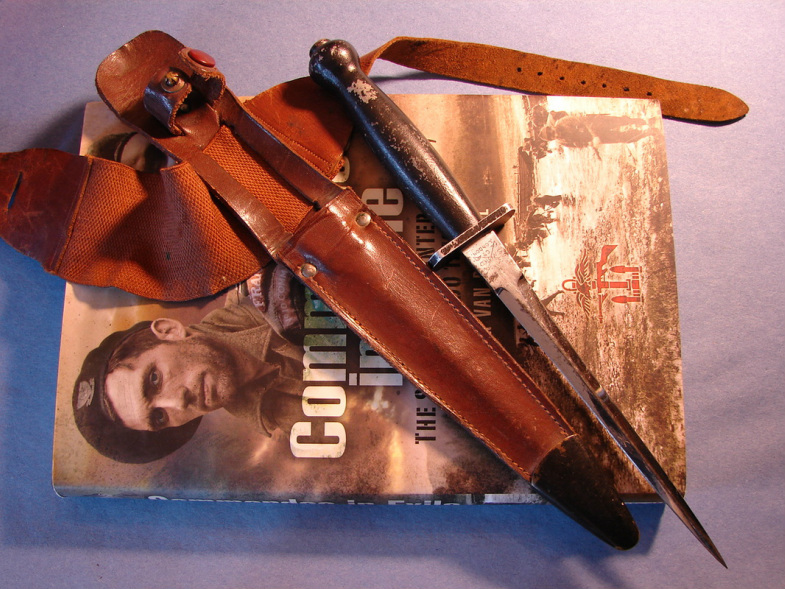
The handle of this delicate poignard is made from cast aluminum. The crossguard is also aluminum and both are blackened. Deadly, needle-tipped, the blade is approximately six inches long. This dagger came with its original brown leather sheath, metal tipped chape and with the straps set-up for wearing on your sleeve or leg. It is an exquisite little killing knife.
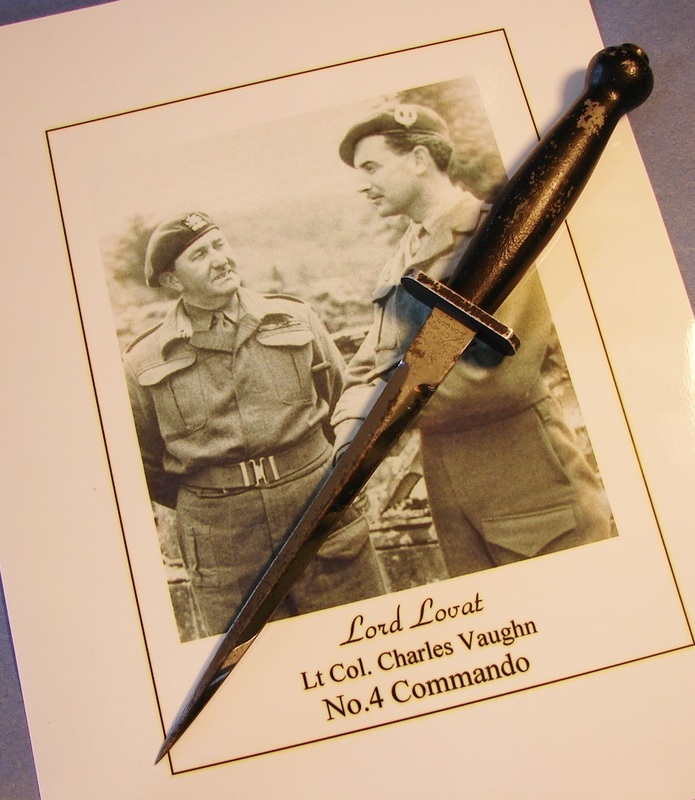
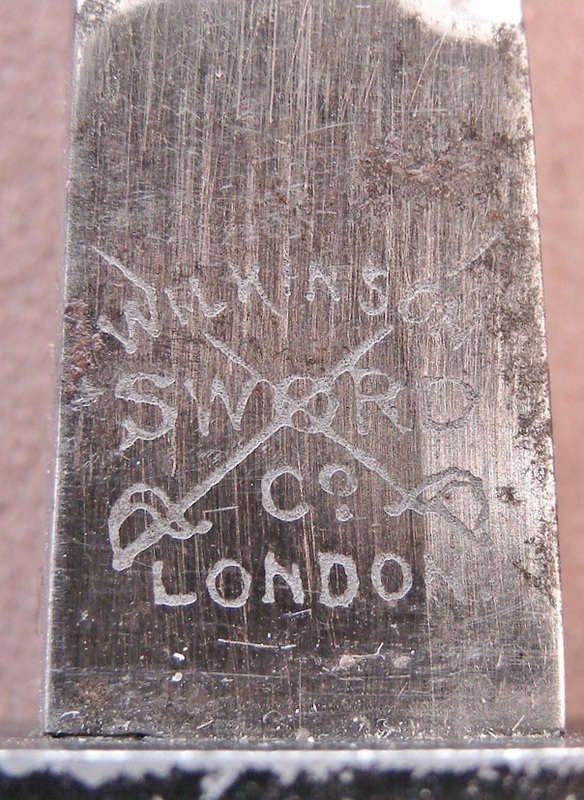
Lord Lovat is shown at the right side of this photo. Robert Wilkinson -Latham advised me that the logo (on the right) was a correct etching transfer from the early 1940s, more often found on sword blades because of their being quite narrow.
|
|
Tom Beasley Famed Swordsmith:
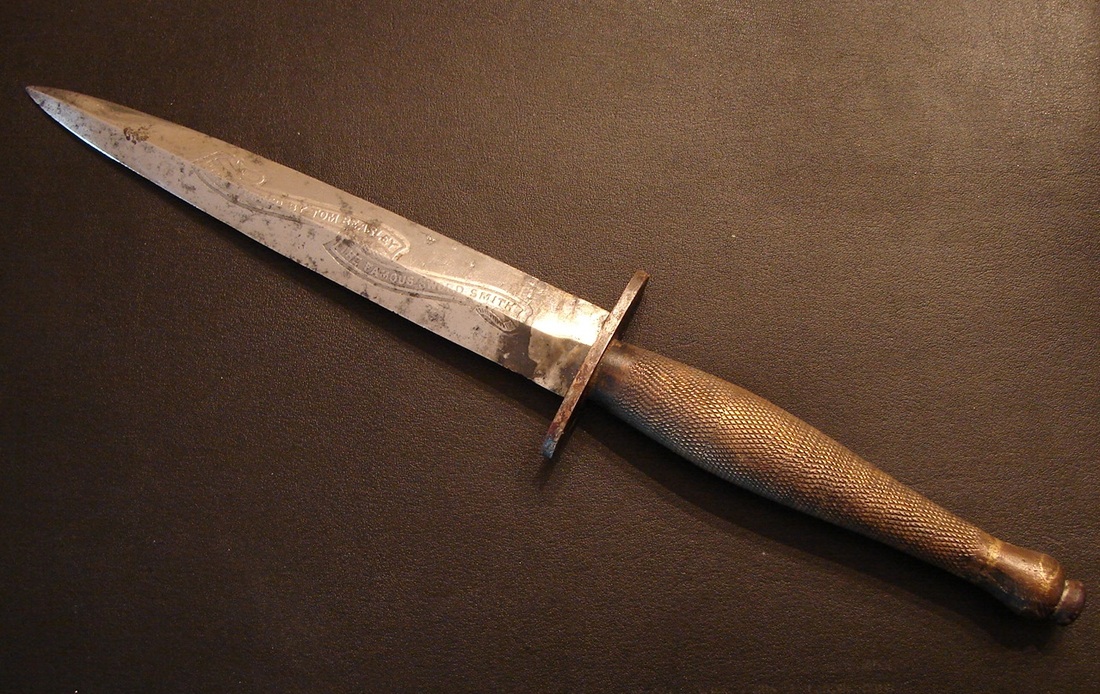
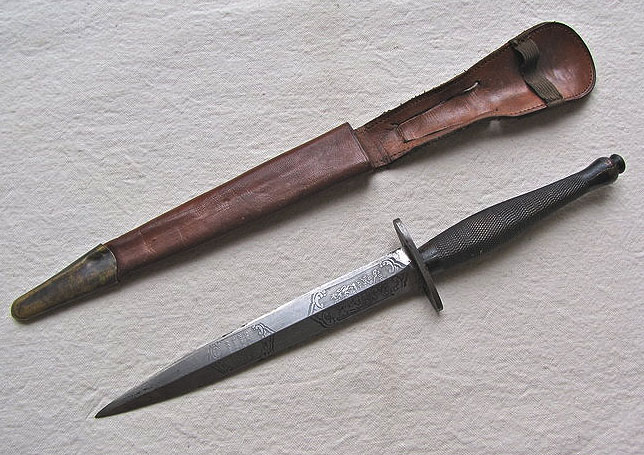
Below: Here we have a second Tom Beasley Fairbairn-Sykes. It is not in the best condition but the selling price reflected that. There is no finish left on the knife and the blade suffered some rust staining which has mostly been cleaned off. You can imagine my shock when I tried to clean off the dark staining in front of the guard and found that the blade was at one time broken in half and repaired! The repair was skillfully done and hardly noticeable. Rather than send it back I decided to give this broken hero a home. Since it is a Beasley we know the knife did not serve during the war so whatever caused the catastrophic failure of the blade remains a mystery. Unfortunately the family information promised to me about the Veteran was never passed on to me.
Below: Here we have a second Tom Beasley Fairbairn-Sykes. It is not in the best condition but the selling price reflected that. There is no finish left on the knife and the blade suffered some rust staining which has mostly been cleaned off. You can imagine my shock when I tried to clean off the dark staining in front of the guard and found that the blade was at one time broken in half and repaired! The repair was skillfully done and hardly noticeable. Rather than send it back I decided to give this broken hero a home. Since it is a Beasley we know the knife did not serve during the war so whatever caused the catastrophic failure of the blade remains a mystery. Unfortunately the family information promised to me about the Veteran was never passed on to me.
|
|
|
|
Swordsmith Tom Beasley:
Production numbers for knives by the "Famous Swordsmith" are said to be in the range of 500 or so. The majority of them were fitted with Ivorine (faux ivory) handles rather than this P-2 style handle. I prefer this brass handle as it is more durable and properly balances the knife. The story has it that Beasley, being in his 80s, probably did not make any of the knives but instead oversaw their production. He was most famous for forging the sword that as given by the King of England to the people of Stalingrad for their courage during the war.
Production numbers for knives by the "Famous Swordsmith" are said to be in the range of 500 or so. The majority of them were fitted with Ivorine (faux ivory) handles rather than this P-2 style handle. I prefer this brass handle as it is more durable and properly balances the knife. The story has it that Beasley, being in his 80s, probably did not make any of the knives but instead oversaw their production. He was most famous for forging the sword that as given by the King of England to the people of Stalingrad for their courage during the war.
|
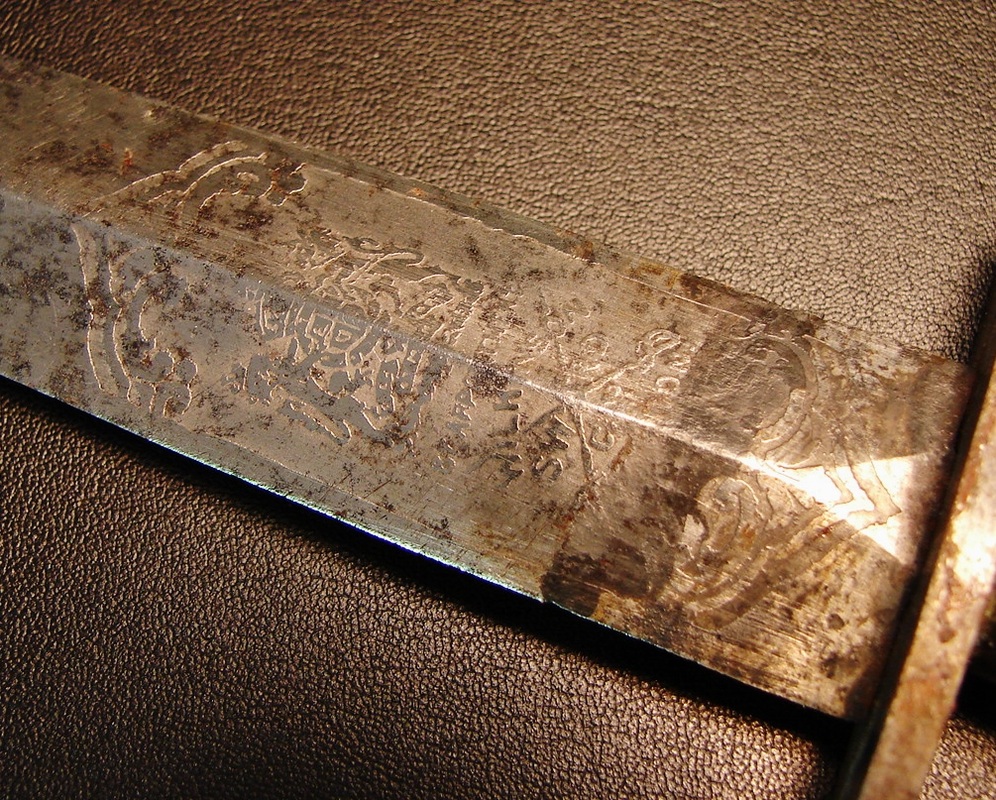
Illustrated here is the long logo (also known as the Masonic logo) for Wilkinson Sword Co. Post-war knives.
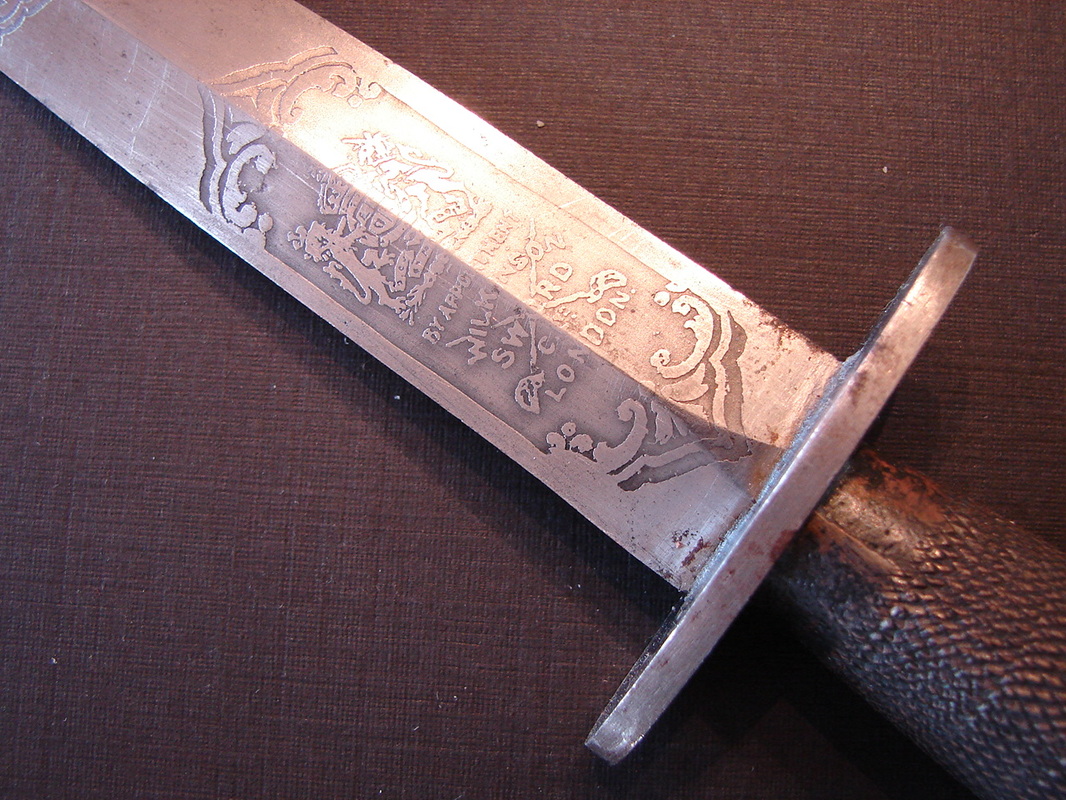
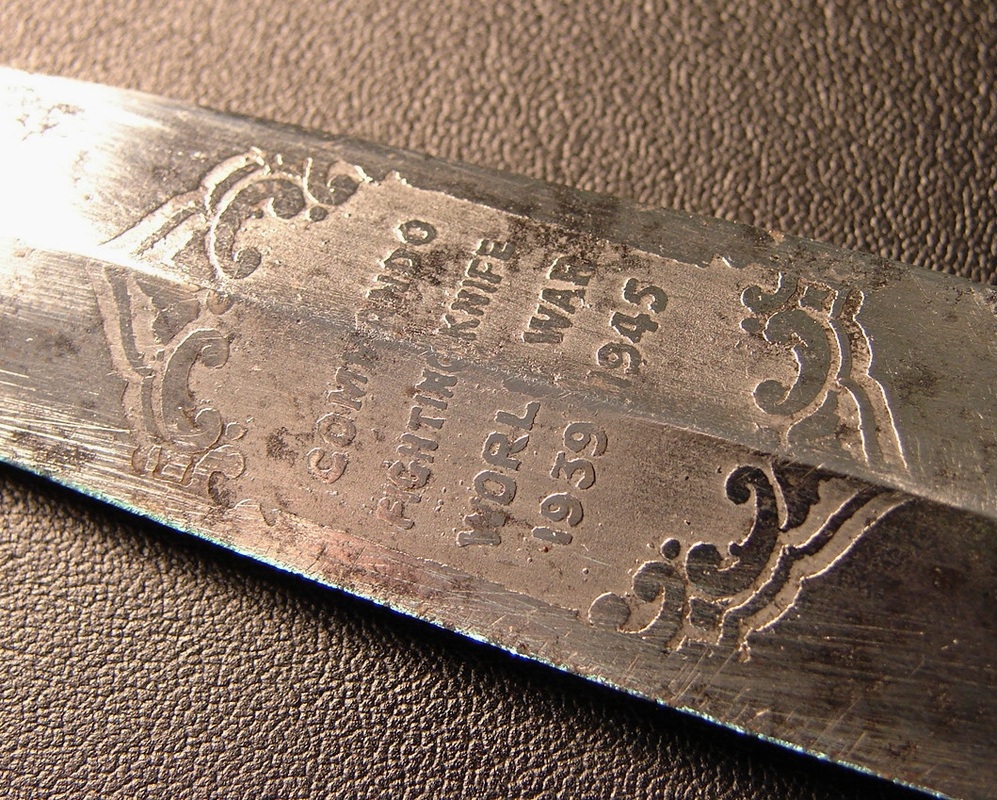
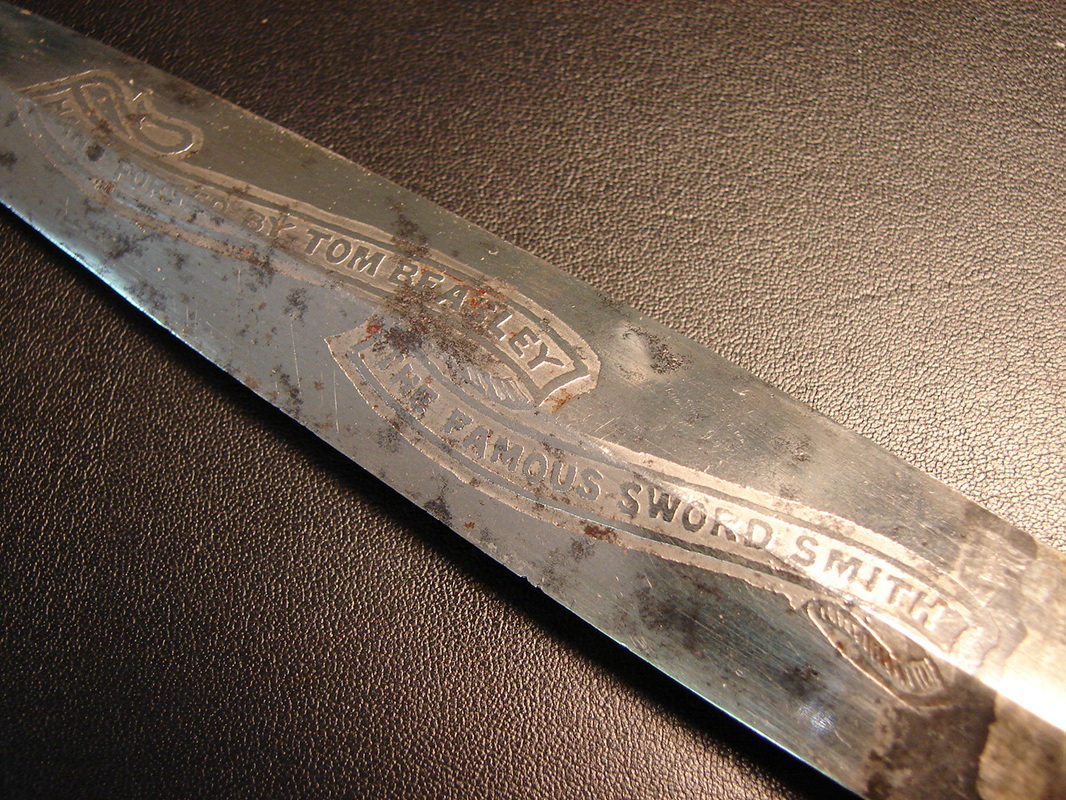
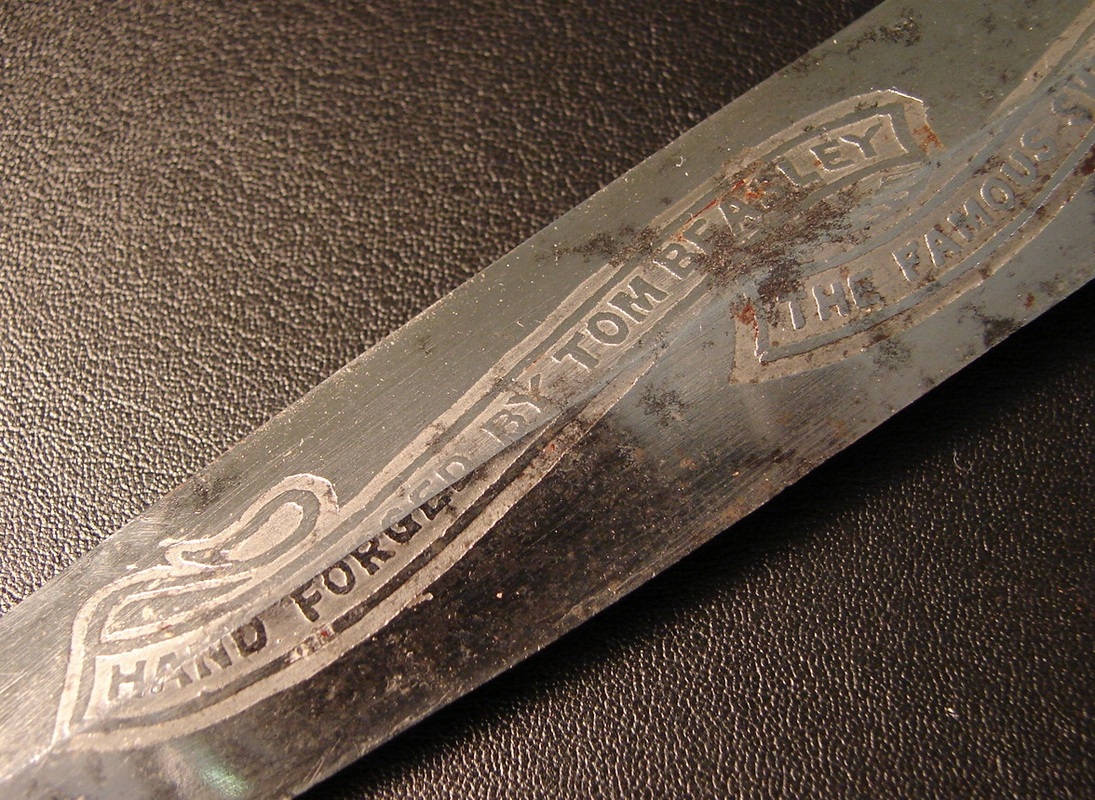
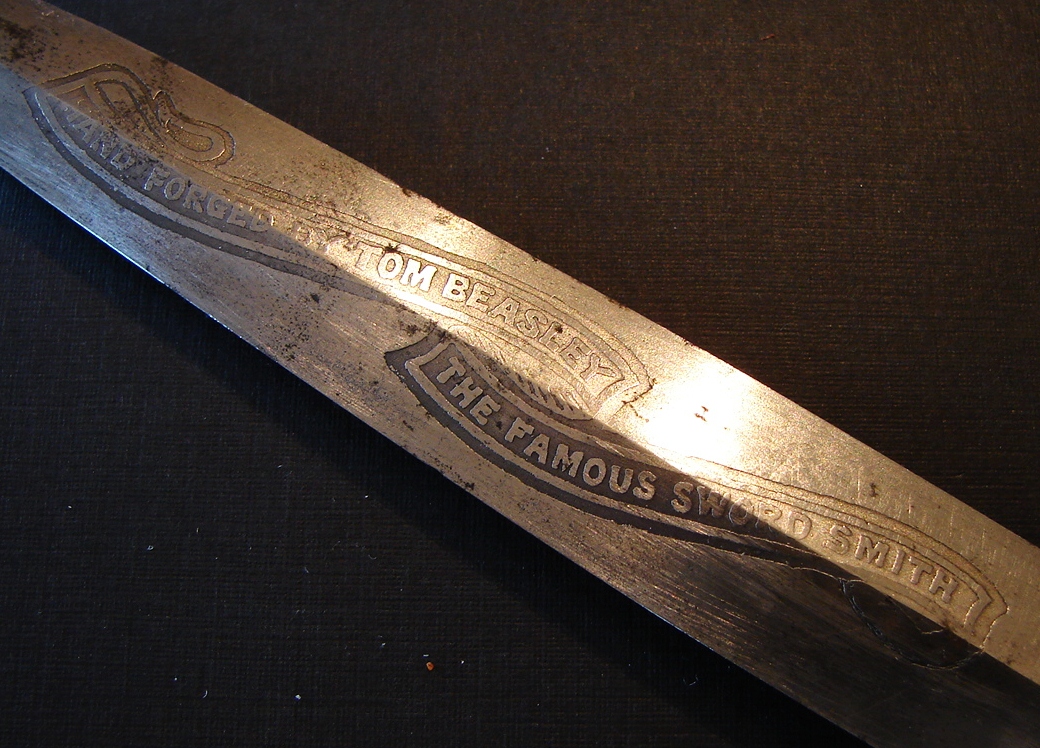
"Hand Forged by Tom Beasley The Famous Swordsmith". It appears that Tom Beasley did little or no forging of these blades and simply worked in a supervisory capacity. No matter, they are still quite rare and we are very happy to have this one in our collection.
|
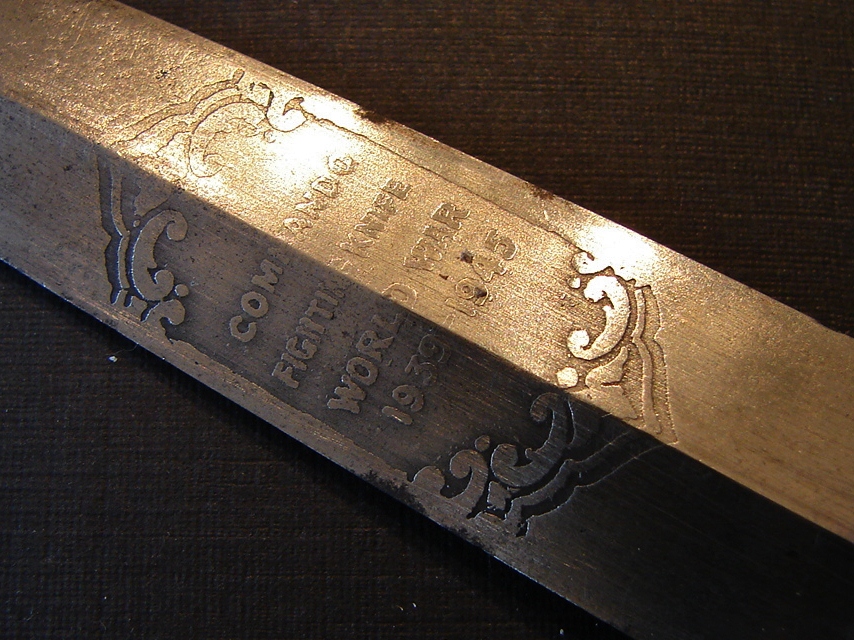
"Commando Fighting Knife World War 1939-1945"
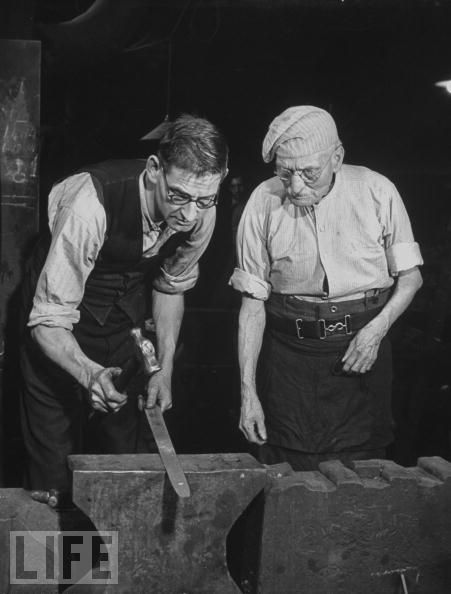
Here is a photo of Tom Beasley (right) advising/consulting with another smith at the forge. The credits for the photo are quite obviously, Life Magazine, circa 1950s.
|
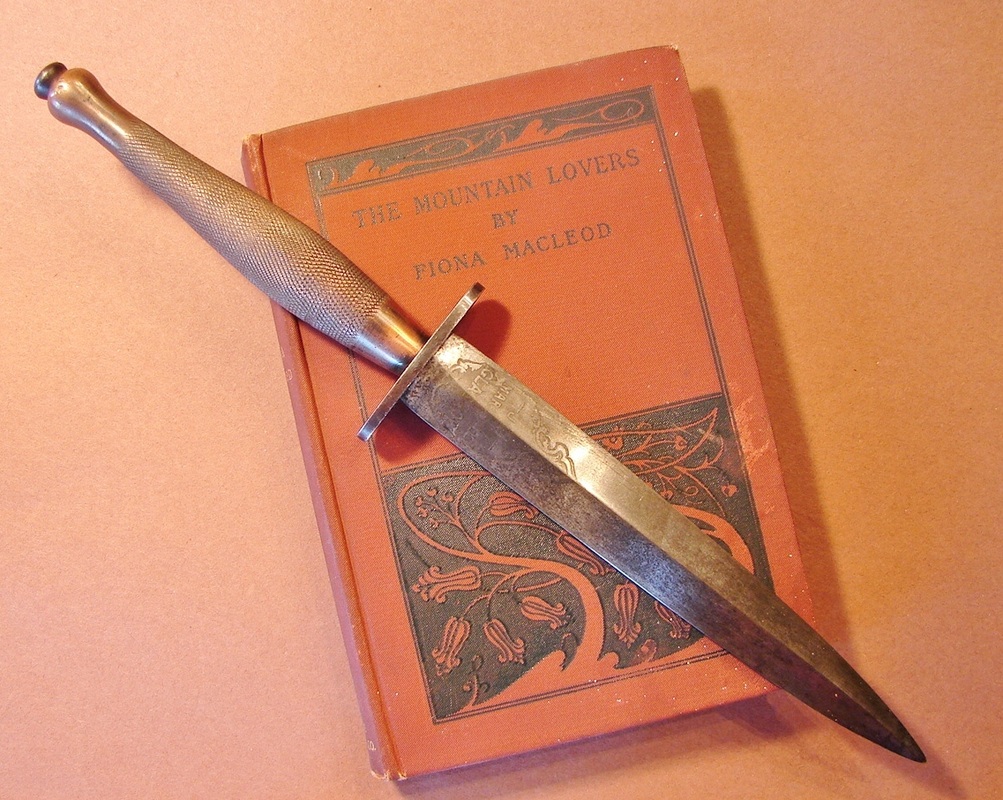
J & I Marshall Glasgow, Scotland: This has been a stellar year or two for our collection. (Not so good for my bank account!) We have found some very nice and rare knives. It Becomes harder and more expensive to add these to our collection but it is my new 401c. Roy has a nose for ferreting out these knives. At one time rumors were that the Marshall knives were made by J. Clarke & Sons. Others say Wilkinson Sword Co. made them.
|
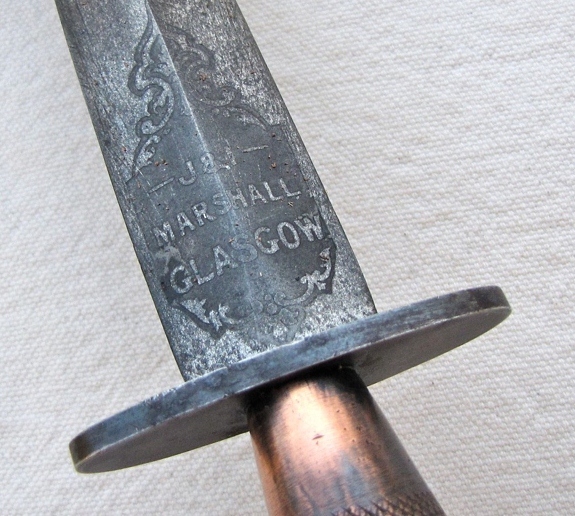
Right: The blade patina is unusual and almost looks as though it had a light application of cold blue applied to purposely darken the blade. It is indeed a splendid knife and I thank Roy again for his assistance and for this photo of the logo. As a side note, the book in the photo is one of many written by 19th cent. Celtic Romantic and visionary William Sharp who wrote under the pen name of Fiona MacLeod. Sharp was born in Paisley Scotland in 1855. I thank my mentor the abbot William MacCrea for introducing me to the writings of Fiona MacLeod.
Roy Shadbolt's Description: "One of the most difficult Wilkinson F-S Knives to find, this retailer marked Second Pattern has the ricasso etched ‘J & I Marshall Glasgow’. Unfortunately much of the original finish to this rare knife has long gone. The good news is that although the blade is stained throughout the etching is still strong and undamaged. The blade itself is full length at 6 3/4”. Although the condition of this example is less than perfect the extreme scarcity makes it one of the most desirable of Wilkinson F-S knives and an incredible find, Marshall knives almost ‘never’ turn up! The scabbard is in superb condition and although correct for this knife is likely a replacement as it is a very tight fit for the broad hand-ground blade." |
|
Polish F~S Knife:
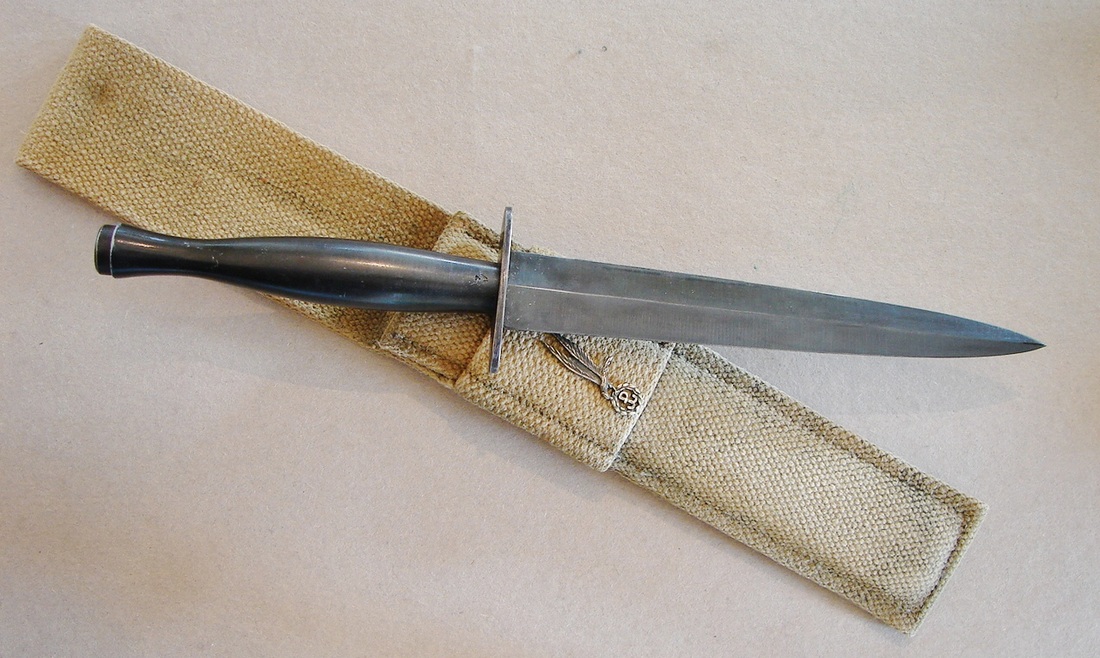
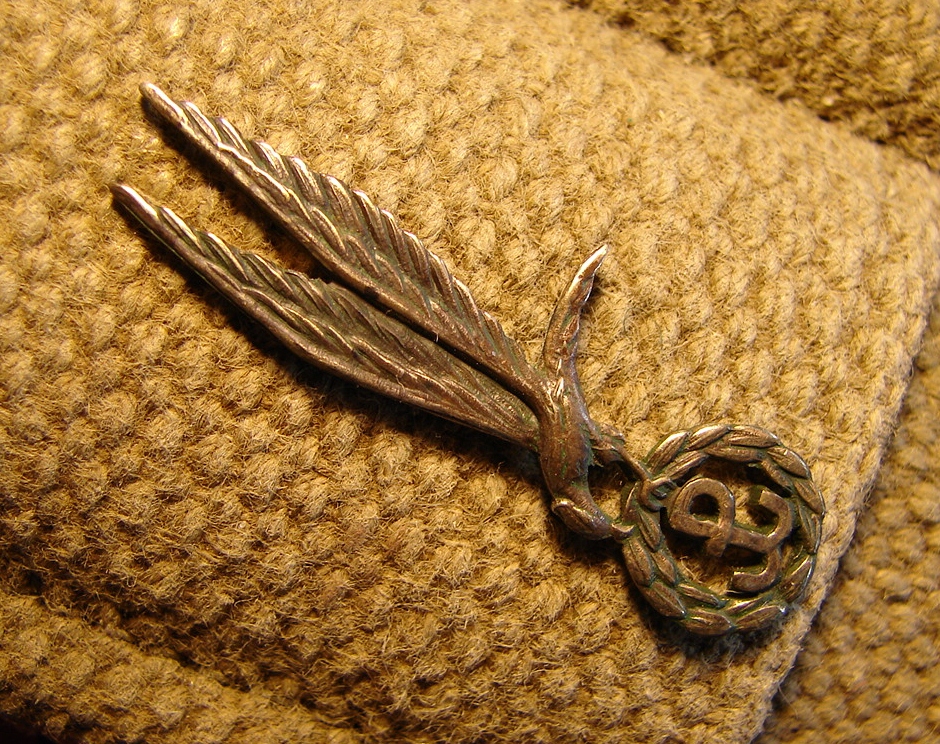
The smooth handled Polish F~S are some of the rarest of WW-II Commando knives. No one has offered a rationale for the smooth grip. The one I have (shown here) came in the leather lined, canvas web sheath with the Polish emblem attached. A very clean knife but not too inspiring.
The smooth handled Polish F~S are some of the rarest of WW-II Commando knives. No one has offered a rationale for the smooth grip. The one I have (shown here) came in the leather lined, canvas web sheath with the Polish emblem attached. A very clean knife but not too inspiring.
|
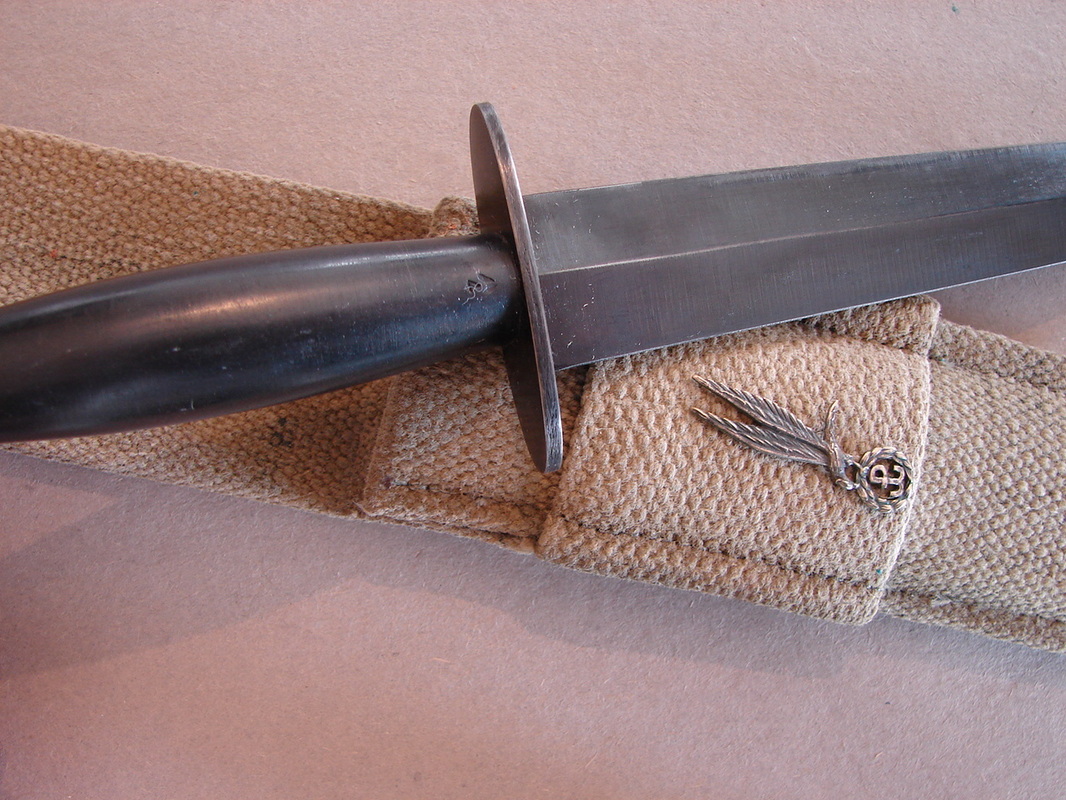
Below: Close-up of the completely smooth handle and third pattern weight blade. It is in excellent shape and stamped with something resembling a broad arrow, but not quite, and the numeral "4".
|
|
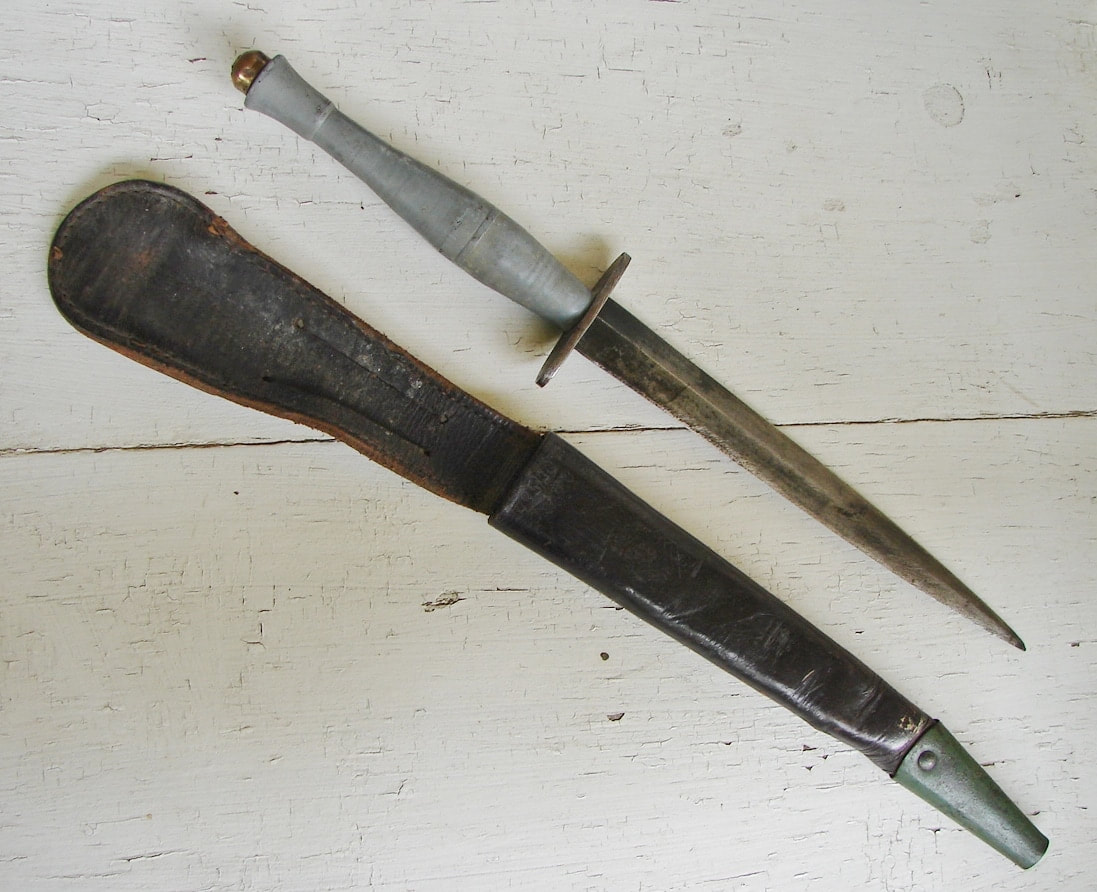
Below: Here is an example of a "non-Polish" knife. Many people try to explain away the true Polish daggers by saying they are either fakes, or third pattern knives with the handles turned smooth. This knife clearly shows what a third pattern with the rings removed looks like, and it does not look like a genuine Polish F-S dagger. I actually prefer the feel of this handle over a standard ribbed third pattern handle.
Below: McLeod Metallurgy:
I owe Roy Shadbolt a debt of gratitude for identifying this rare knife. The entire knife was cast in one piece and machined to finished shape by McLeod Metallurgy of Quebec, Canada. According to Roy these pieces were given as Christmas gifts in 1943 to showcase McLeod's expertise at metal working. He says they were not intended to be used as weapons but mine was clearly sharpened and fitted into a F~S sheath. As you can see, this handle is shaped like a P-2 but is not knurled. What is less obvious is the handle, guard, and blade are all cast as one piece. There are grinding or sanding marks encircling the handle from the finishing/shaping process.
I owe Roy Shadbolt a debt of gratitude for identifying this rare knife. The entire knife was cast in one piece and machined to finished shape by McLeod Metallurgy of Quebec, Canada. According to Roy these pieces were given as Christmas gifts in 1943 to showcase McLeod's expertise at metal working. He says they were not intended to be used as weapons but mine was clearly sharpened and fitted into a F~S sheath. As you can see, this handle is shaped like a P-2 but is not knurled. What is less obvious is the handle, guard, and blade are all cast as one piece. There are grinding or sanding marks encircling the handle from the finishing/shaping process.
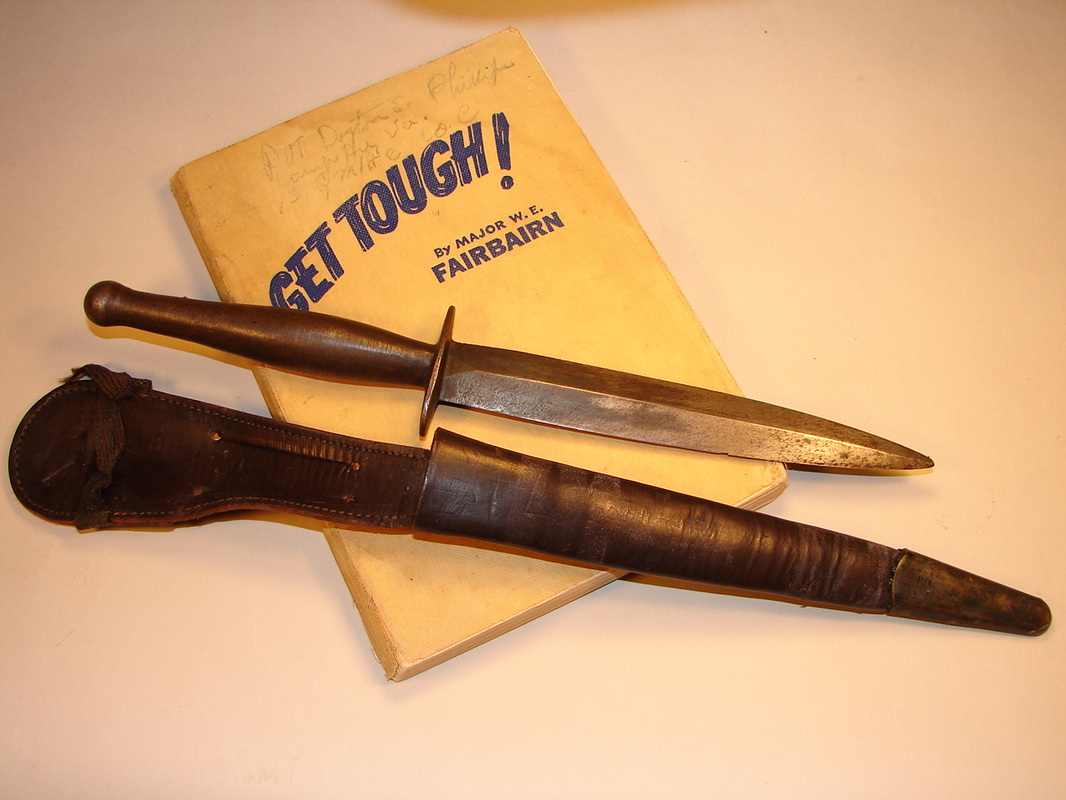
Below: This photo is another McLeod Metallurgy knife shared with us by a reader. Note part of the original paper label remains intact.